Wednesday, May 21, 2008

Czech Retail Sales March 2008

Czech retail sales showed fell month on month, and year on year in March, after 51 months of consecutive growth. The data were partly influenced by seasonal factors (Easter was in March)and but also provided some evidence of a trend towards slowing consumption. Retail sales fell 2.9 percent year-on-year in March, compared to a 6.3 percent growth in February, data from the Czech statistical office (CSU) showed today. The office said that a drop in sales of pharmaceuticals and food, along with the Easter holiday were the main factors behind the drop.


In March, seasonally adjusted sales in retail trade except of automotive segment dropped by 0.6%, month-on-month, at constant prices, and in the year-on-year comparison, sales increased by 0.7%. Seasonally non adjusted sales dropped by 2.1% after 51 months of incessant growth. The y-o-y sales decrease was recorded in the sale of food, beverages and tobacco and also in the non-food goods sale. Seasonally adjusted sales in automotive segment dropped by 2.2%, m-o-m, at constant prices, in the year-on-year comparison by 0.1% and not seasonally adjusted by 4.4%. Seasonally adjusted sales in hotels and restaurants decreased, m-o-m, by 0.5% and not seasonally adjusted dropped by 3.4%, year-on-year.
CSU Statistics Office


The figures were definitely influenced by seasonal factors and the fact there were two less working days. Overall, however, when adjusted to take allowance of this there is still clearly a deceleration trend.

Thursday, May 15, 2008

Czech GDP Q1 2008

The Czech Republic's economy expanded 5.4 percent in the first quarter, the slowest pace in more than three years, as consumer spending waned. The preliminary growth figure compares with 6.6 percent in the previous three-month period, the Czech Statistical Office said today. Seasonally adjusted GDP growth was also 5.4 percent, while quarter on quarter the economy expanded 0.9 percent.


The expansion has faltered as household consumption was damped by higher indirect taxes and surging inflation, which has been above Ceska Narodni Banka's ceiling since November. Inflation has been driven by global increases in food and fuel costs and government measures that are beyond the bank's influence.

The increase of economic performance was partially connected also with higher employment. According to an estimate that used the results of the labour force sample survey in combination with currently available administrative data, seasonally adjusted total employment in Q1 2008 increased by 0.3% quarter-on-quarter and by 1.7% year-on-year. NSA employment was by 1.9% higher year-on-year.


A third of the increase of economic performance was due to higher employment; the remaining two thirds are attributable to the growth of total labour productivity. The trend of certain price segments varied considerably – a marked seven per cent price growth of household expenditure on the one hand, and by 1.3 p.p. higher decrease of export prices than of import prices on the other. These and other impacts partially compensated one for another so that the overall price level measured by GDP deflator increased by three per cent.


The decreasing effect of domestic demand on GDP growth, along with an appreciating koruna, has added to the central bank's optimism that the inflation rate will slide back to the mid-point 3 percent target by next year, from 6.8 percent in April. A strong koruna, which has gained 6.1 percent against the euro this year, has helped temper rising prices

Consumer prices grew more than 7 percent in each of the first three months of 2007 and a close to a decade high of 7.5 percent in February. Rising prices prompted the central bank to raise its benchmark two-week repurchase rate to 3.75 percent in February, the fifth increase since May 2007.

Monday, May 12, 2008

Czech Industrial Output March 2008

Industrial output data for March showed the first drop after 5-1/2 years of growth, adding to previous poor purchasing managers index (PMI) and foreign trade figures.
Output fell 2.1 percent year-on-year in March, far worse than a 4.8 rise forecast by analysts and in stark contrast to an 11.3 percent rise the previous month.
The Czech data mirrored March results elsewhere in emerging Europe. In Slovakia, the region's growth leader, output slammed on the brakes to grow just 1.8 percent.
Part of the drop could be attributed to the Easter holiday, which came earlier than usual this year.

Czech Unemployment April 2008

The Czech unemployment rate fell in April, reinforcing concerns that the tight labour market poses a serious risk for the development of inflation.

Unemployment fell to 5.2 percent in April from 5.6 percent in the previous month, and in line with expectations in a Reuters analyst poll, data from the labour and social affairs ministry showed. Year-on-year, unemployment fell from 6.8 percent registered in April 2007.

Wages in industry are growing growing above 11 percent which reinforces the Czech central bank's concerns that the tight labour market and growing wages are the key upside risks to inflation.

On April 30, 2008 job offices registered altogether 316,118 job seekers. That is by
20,179 less than at the end of March. The number of job seekers decreased by 86,814 persons compared with the same period of the preceding year. The number of available job seekers job seekers currently available for work) was 292,465.


In the course of April, job offices registered altogether 42,515 newcomers. That is by 4,484 job seekers more than in the preceding month and by 1,659 newly registered job seekers more than in April of the preceding year. In April, job offices registration was terminated with 62,694 seekers. New jobs have been taken up by – 42,596 persons. In the course of the above-said month, job offices excluded 20,098 job seekers due to other reasons.


Harmonized unemployment rates (EUROSTAT) was 4.6 % in March 2008.

Czech Inflation April 2008

The Czech Republic's April inflation rate fell less than economists forecast, raising the prospect that the central bank will hold off on cutting interest rates in the near future. The inflation rate dropped to 6.8 percent from 7.1 percent in March and a near decade-high of 7.5 percent in February, the Prague-based statistics office said today. The central bank forercast was for a rate of 6.7 percent. Consumer prices rose 0.4 percent in the month, following a 0.1 percent drop in March.


Housing costs were 0.6 percent higher than in March, led by a 2.9 percent increase in natural gas prices for households. Prices of food increased half a percent from March, following two months of a decline, and were 9.6 percent higher compared with March last year.

The inflation rate has exceeded Ceska Narodni Banka's 4 percent ceiling since last November, driven by global increases in food and fuel costs and government spending measures that are beyond the bank's direct influence.

The Czech central bank said today in a statement posted on its Web site that inflation has passed its peak and its expects price growth to return to ``low levels corresponding to its targets at the end of 2008 and the beginning of 2009.''

However the bank did say the reading exceeded its forecast as a result of higher-than-expected adjusted inflation without fuels which "could signal continuing inflationary pressures from the domestic economy."

The central has relied on the koruna's 12 percent gain against the euro in the past 12 months, slowing economic growth and the mitigating effect of regulated price growth to curb inflation to 2.9 percent in the first quarter and to 2.2 percent in the third quarter of 2009.

The Czech National Bank left its benchmark interest rate unchanged at 3.75 percent for a second consecutive meeting last week continuing to bank on the impact of a strong koruna and a developing economic slowdown to damp inflation.

Wednesday, May 07, 2008

Czech Imports and Exports March 2008

In March 2008, according to preliminary data, exports and imports at current prices fell by 5.6% and 2.4% year-on-year, respectively. At the same time the trade balance reached a surplus of CZK 8.1 billion in March, CZK 7.4 billion less than March 2007. The balance was unfavourably influenced by a CZK 4.9 billion decrease of surplus in machinery and transport equipment and by a CZK 3.7 billion increase the deficit for mineral fuels, lubricants and related materials.


According to preliminary data, seasonally adjusted exports decreased by 6.2% and imports by 9.0%, month-on-month. The trend component fell by 1.2% in exports and rose by 0.2% in imports.

The March results were influenced by the smaller number of working days (March 2008 had two working days less than March 2007), the presence of the Easter holiday and by the high comparative base of March 2007.

Exports recorded the biggest fall since August 2002 and imports the biggest since May 2005. The last year-on-year decreases were registered in January 2004 (-0.2%) for exports and in July 2005 (-2.0%)for imports. Due to appreciation of the koruna against the euro and even more against the US dollar, external trade grew faster when measured in euros (exports +5.0% and imports +8.5%) and US dollars (exports +23.1%, imports +27.2%) than in korunas.

The Czech currency has strengthened by 12 percent against the euro in the past 12 months and is the world's second best-performing currency against the dollar over the past year.

The trade balance had a surplus of CZK 8.1 billion, which was down CZK 7.4 billion, year-on-year, registering the largest year-on-year fall since April 2003. The trade balance with EU states was positive by CZK 41.1 billion and with non-EU states negative by CZK 33.0 billion.


Trade balance was negatively influenced by the fall of surplus of trade in ‘machinery and transport equipment’ (by CZK 4.9 billion) and by the growth of deficit of trade in ‘mineral fuels, lubricants and related materials’ (by CZK 3.7 billion). Surplus of trade in ‘miscellaneous manufactured articles’ dropped by CZK 0.9 billion and the trade balances of ‘chemicals and related products’, ‘manufactured goods classified chiefly by material’ and ‘beverages and tobacco’ remained on the same level as in March 2007. Trade balance improved in ‘food and live animals’ (deficit down by CZK 1.5 billion) and ‘crude materials, inedible, except fuels’ (surplus up by CZK 0.4 billion).

Total exports of ‘machinery and transports equipment’ fell by 6.0% (CZK 7.2 billion), of which the biggest decreases were recorded in ‘road vehicles’ (CZK 3.9 billion), ‘other transport equipment’ (CZK 1.1 billion) and ‘general industrial machinery and equipment’ (CZK 0.7 billion). Total imports of ‘machinery and transport equipment’ were down by 2.7% (CZK 2.3 billion) and the biggest decreases were registered in the same commodity groups as in exports. The biggest increase in imports was achieved in ‘telecommunications and sound-recording equipment’ (CZK 1.9 billion).

Higher imports of ‘mineral fuels, lubricants and related materials’ by 36.0% (CZK 5.2 billion) were mainly due to higher imports of crude petroleum (+44.7% in value, +6.2% in volume) and natural gas (+47.2% in value, +39.2% in volume).

By group of countries, trade surplus with EU states dropped by CZK 7.3 billion and trade deficit with non-EU states increased by CZK 9.5 billion. Trade surplus grew with France (by CZK 2.6 billion), Romania (by CZK 1.3 billion), Ukraine (by CZK 0.5 billion) and Poland (by CZK 0.4 billion). Trade balance improved with Finland (by CZK 0.4 billion) as deficit turned into a surplus. Trade deficit rose with the Russian Federation (by CZK 3.3 billion), China (by CZK 1.2 billion) and Japan (by CZK 0.8 billion). Trade surplus deteriorated with Kazakhstan (by CZK 0.9 billion), Serbia (by CZK 0.8 billion) and the United States (by CZK 0.6 billion) as surplus turned into a deficit. Trade surplus fell with Austria (by CZK 0.6 billion), Germany (by CZK 0.5 billion) and Slovakia (by CZK 0.1 billion).

In the twelve months to March 2008, compared with the previous twelve months, exports and imports grew by 12.0% and 11.1%, respectively. The trade balance reached a surplus of CZK 81.4 billion, which was an improvement of CZK 27.5 billion.


Favourable development was reported for trade in ‘machinery and transport equipment’ (surplus up by CZK 36.8 billion), ‘crude materials, inedible, except fuels’ (surplus up by CZK 8.6 billion), ‘food and live animals’ (deficit down by CZK 2.8 billion)), ‘animal and vegetable oils, fats and waxes’ (deficit down by CZK 1.2 billion) and ‘beverages and tobacco’ (improvement by CZK 1.2 billion as deficit turned into a surplus). Trade balance deteriorated in ‘chemicals and related products’ (deficit up by CZK 12.2 billion), ‘manufactured goods classified chiefly by material’ (surplus down by CZK 8.0 billion) and ‘miscellaneous manufactured articles‘ (surplus down by CZK 2.3 billion) and ‘mineral fuels, lubricants and related materials’ (deficit up by CZK 0.4 billion).


By group of countries, trade surplus with EU states rose by CZK 65.5 billion and trade deficit with non-EU states increased by CZK 38.0 billion. Deficit decreased in trade with the Russian Federation (by CZK 21.0 billion); and surplus rose in trade with Slovakia (by CZK 15.3 billion), France (by CZK 12.8 billion), the United Kingdom (by CZK 10.3 billion), Italy (by CZK 7.8 billion), Poland (by CZK 7.3 billion) and Germany (by CZK 1.0 billion). Trade balance improved with the Netherlands (by CZK 7.1 billion) and Norway (by CZK 6.7 billion) as deficit turned into a surplus. Trade deficit grew with China (by CZK 48.5 billion), Japan (by CZK 15.8 billion), Thailand (by CZK 7.0 billion), Korea (by CZK 5.4), Ireland (by CZK 5.0 billion) and the United States (by CZK 5.4 billion). Trade surplus fell with Austria (by CZK 8.1 billion) and Hungary (by CZK 6.6 billion).

Czech National Bank Holds Interest Rates

The Czech National Bank left its benchmark interest rate unchanged for a second consecutive meeting today as it banks on the strong koruna and an economic slowdown to damp inflation. The Ceska Narodni Banka seven-member board kept its two-week repurchase rate at 3.75 percent.


The inflation rate, at 7.1 percent in March, has exceeded the central bank's 4 percent ceiling since November. Still, policy makers, who doubled borrowing costs over the past 2 1/2 years, are reluctant to lift rates further as the strong koruna and a global economic slowdown threaten to weigh on local exporters and stifle economic growth more than anticipated.

The Czech currency's strengthening of 12 percent against the euro in the past 12 months may contain inflation by holding down import price growth and weigh on economic growth. The koruna was trading at 25.138 against the euro as of 2:34 p.m. in Prague, compared with 25.207 yesterday.

Rate setters consider the current inflation spike a one-time event, triggered by factors outside of the central bank's reach. They are concerned about the second-round effects of unexpectedly fast price growth, including accelerated pay increases after unemployment slid to an 11-year low.

In its last staff prognosis from February, the central bank predicted the inflation rate to drop to 3.4 percent in the first quarter of 2009 and 2.3 percent between July and September 2009.

The bank's target is 3 percent plus or minus a percentage point. When setting rates, policy makers focus on 12-18 months ahead, when their current decisions should have worked through the economy.

The main Czech lending rate is a still a quarter percentage point lower than the ECB's benchmark rate. Any eventual rate increase could spur additional gains to the koruna, which already is the world's second best-performing currency against the euro and dollar in the past year.

The central bank three months ago forecast the economy will expand 4.1 percent this year and 4.6 percent in 2009, compared with a record growth rate of 6.5 percent last year.

Thursday, April 24, 2008

OECD Warn The Czech Republic on the Economic Impact of Ageing

The Czech Republic must cut public spending, boost the retirement age and raise health-care co-payments to preserve economic growth, the Organization for Economic Cooperation and Development said in its most recent country survey out today.

The Czech Republic needs to be more ambitious in setting deficit targets while economic growth is at its current high levels, the OECD said in its 2008 country survey. It advised the Cabinet to support health-care and pension overhauls as the country's ageing population may start straining state resources as early as 2012.

The Civic Democrat-led three-party coalition this year introduced a flat income tax and medical fees and limited some social transfers to keep the public-spending shortfall below the European Union's threshold of 3 percent of gross domestic product. It also has plans to revamp the health-care and retirement system, though these may be jeopardized by the coalition's thin majority in Parliament, the OECD warned.

``To maintain these high growth rates, further reforms are necessary,'' OECD Secretary General Angel Gurria said today at a Prague press conference. ``If policy is not changed, spending will increase considerably'' amid a ``rapid pace of aging.''


The OECD urged Czech authorities to consider a ``full liberalization'' of rents, take steps to dscourage early retirements and reduce the length of parental leave to boost workforce supply (really I am not in agreement at all with this latter point, but I will need to find time for a longer post to explain why). It reiterated that tuition for university students is necessary to extend the number of people with higher education.


``Most important is a need to ensure fiscal sustainability through public-finance reform to put the economy in a better shape to cope with population aging,'' the OECD said. ``The current government made a positive start'' with ``a fiscal package that includes wide-ranging tax and spending reforms, many of which are aimed as first steps in more ambitious reform.''


``The recent global financial turmoil has so far not affected the economy, although weaker growth elsewhere may have some impact,'' it said. ``There is little sign of overheating so far; underlying inflation has remained moderate.''


The government earlier this month approved the outlines of an overhaul of the health-care system that includes allowing health insurers to make a profit. The Health Ministry's plan to sell all but one state-financed health insurer is opposed by two smaller coalition parties, however.


``The impact of the second phase of reform could be significant in strengthening competition on the quality and cost of services,'' the OECD said. ``Putting legislation through parliament is an uphill struggle because the coalition itself has a thin majority'' and ``as a result, many of these further reforms are uncertain.''


Concerning a change of the current pay-as-you-go pension system, the OECD recommends that ``mandatory'' transfer of social security payments to private pension funds be adopted rather than implementing the current proposal that would employees to choose between the two systems.

``Providing a permanent choice risks additional public expense because net contributors are likely to switch while net beneficiaries will stay with the full PAYG pension,'' the organization said.


The Czech Republic has dropped the 2010 entry date as a target for euro-adoption and has not set a new date. The government's strategy is to carry out long-term structural changes and allow the economy to close the distance with the richer euro-sharing nations to try and avoid an outcome whereby letting go of the possibility of an appreciating koruna doesn't trigger additional price growth (a problem that may arise in neighbouring Slovakia if the current entry bid is accepted). This government concern is shared by the OECD.

``A consequence of entering the euro area is that, with the loss of the exchange-rate channel, inflation has to do all the work in nominal convergence,'' the OECD said. However, ``delaying entry implies accumulating opportunity costs because it postpones the gains from adopting the euro.''

Wednesday, April 23, 2008

Czech Growth Forecast revised Up

The Czech Finance Ministry has said today that it expects the economy to grow faster than originally expected this year as tax cuts and an inflow of funds from the European Union should boost economic activity. The ministry forecast gross domestic product to expand 4.9 percent, compared with a January estimate of 4.7 percent. It left its prediction for 2009 GDP growth at 5.1 percent. The economy grew a record 6.5percent last year.

The Jan. 1 introduction of a flat rate income tax and measures restricting social and health-care expenses should help ofset a growing shortage of workers and the negative effect the fastest inflation in 10 years on household spending, the ministry said. It raised its forecast for the average inflation rate to 6 percent from 5.5 percent in the previous forecast.

``The Czech Republic will remain a dynamically developing economy, attractive for foreign investors'' and ``the positive effects of fiscal reform and inflow of EU funds will be gradually seen,'' the ministry said. ``Reforms underway will reduce limiting factors and contribute to acceleration of economic growth.''


The Czech Republic may receive as much as 26.7 billion euros ($42.4 billion) from the EU in the period of 2007 to 2013.

The koruna is expected to weaken from the current levels to an average 25.8 against the euro this year before it rises to 25.4 a year later, the ministry estimated. The currency was at 25.052 per euro as of 5:52 p.m. in Prague, compared with 25.045 yesterday.

The unemployment rate will fall to 4.2 percent in 2008 and 3.6 percent in 2009, the ministry said, citing the government's measures adopted on Jan. 1, including a cancellation of automatic indexation of social payments that should prompt people to take a job rather than stay on welfare.


``Reform measures in public finances should lead to higher motivation to work by strengthening net earned incomes at the expense of social benefits, contributing thus to labor market recovery,'' the ministry said.

The current-account deficit is anticipated to represent 3 percent of GDP this year as the economy will generate a record full-year trade surplus of 111 billion koruna, according to the authority. The current-account gap will shrink to 2.1 percent of GDP in 2009, the ministry said.

The Czech budget deficit will continue to narrow to 1.5 percent of GDP this year from 1.6 percent in 2008, the ministry reiterated an estimate from April 21.

Thursday, April 17, 2008

Czech Retail Sales February 2008

Czech retail sales growth accelerated to the fastest pace in four months in February fuelled by increased wages and an extra working day. Sales jumped 6.3 percent from February 2007, following a revised 4 percent increase in January, the Prague-based Czech Statistical Office. When adjusted for the greater number of work days this year than last, retail sales were up 4.5 percent.


Nominal industrial wages rose an annual 13.1 percent in February as the inflation rate reached a decade-high of 7.5 percen, although the central bank expect higher prices to put a brake on household consumption later this year, at least that is one of the key assumptions of the central bank's forecast for inflation to drop to its 3 percent goal in 2009, even without further interest-rate increases.

Policy makers, who raised the benchmark interest rate by a combined 1.25 percentage points over the past 11 months to 3.75 percent, are mulling whether inflation will recede fast enough, thanks in part to the koruna's 15 percent gain against the euro since July, or whether an additional rate increase is necessary to ward off a second-round pickup of inflation.

"There are the first signs of demand-pull inflation. Should signs of faster, adjusted inflation persist or strengthen, it would justify a monetary-policy tightening.''
Deputy Central Bank Governor Miroslav Singer

Monday, April 14, 2008

Czech Republic Producer Prices

Producer prices dropped back slightly in March, rising at an annual 5.3% versus the 5.6% registered in February. This is now the second month they have fallen on an annual basis, since in February they were down from the 6% high registered in January.


In March 2008, compared to the previous month, prices of agricultural and industrial producers were up by 1.2% and 0.3%, respectively; prices of construction work and market services grew by 0.5% and 1.4%, respectively.

Industrial producer prices rose by 0.3% (+0.1% in February). The growth of the price level was the most markedly influenced by higher prices of ‘coke, refined petroleum products’ (+3.7%), ‘basic metals and fabricated metal products’ and ‘chemicals, chemical products and man-made fibres’ (+0.6% both). The most significant drop of prices came in ‘food products, beverages and tobacco’ (-0.3%) after successive eleven months of growth. Of these the highest decreases were recorded for the prices of ‘dairy products and ice cream’ (-2.0%), ‘meat and meat products’ (-0.4%) and ‘other food products’ (-0.1%). Prices went down markedly in ‘coal and lignite; peat; crude petroleum’ (-1.2%), ‘wood and products of wood and cork’ (-1.0%) and ‘other manufactured goods n.e.c.’ (-0.9%).

Industrial producer prices grew by 5.3% (+5.6% in February). The price level was influenced most significantly by prices of ‘food products, beverages and tobacco’ which rose by 10.8%, of which prices of ‘dairy products and ice cream’ were up by 17.3%, ‘prepared animal feed’ by 35.6% and ‘other food products’ by 8.6%. Prices of ‘coke, refined petroleum products’ increased by 26.5% and prices of ‘electrical energy, gas, steam and water’ by 9.3%. Prices went down y-o-y particularly in ‘transport equipment’ (-4.0%), of which particularly ‘parts and accessories for motor vehicles and their engines’ (-7.2%). Prices of ‘rubber and plastic products’ dropped by 2.3% and prices of ‘wood and products of wood and cork’ by 2.9% (-1.0% in February), of which ‘wood, sawn, planed or impregnated’ by 13.0%.

Export Prices

In February 2008, export prices decreased by 1.0%, import prices by 1.1%, month-on-month. Year-on-year, export prices fell by 5.0% and import prices by 3.3%. The terms of trade figures reached 100,1%, m-o-m, and 98.2%, y-o-y.


Exports: following the slight month on month growth recorder in January, export prices recovered their downward trend in February and dropped by 1.0%, especially due to the strong appreciation of the koruna. The drop of the total m-o-m export price index came mainly from a 0.9% decrease in prices of 'machinery and transport equipment’ (particularly road vehicles) and 'manufactured goods classified chiefly by material’ by 1.6%. Among other sections important in terms of weight, decreases were recorded for ‘chemicals and related products’ by 1.6%, ‘miscellaneous manufactured articles’ by 1.3% and ‘crude materials, inedible, except fuels’ by 1.2%. Price growth was registered only for 'mineral fuels, lubricants and related materials’ by 1.3%.

Friday, April 11, 2008

Czech Industrial and Construction Output February 2008

Czech industrial output grew 11.3 percent year-on-year in February, compared to 9.3 percent in January and against market expectations of 8.0 percent, data released by the Czech statistical office (CSU) showed.


The average number of persons employed in industry went up by 2.5% year-on-year in February 2008 (+28.6 thousand persons). Increases in average number of persons employed were registered in ‘manufacture of rubber and plastic products’ (+10.0%), ‘manufacture of transport equipment’ (+7.4%) and ‘manufacture of machinery and equipment’ (+6.6%).

Employment decreased most in 'electricity, gas and water supply' (-10.4%), ‘manufacture of textiles and textile products’ (-6.8%) and ‘manufacture of leather and leather products’ (-3.2%).

The average monthly nominal wage in industry rose by 13.1% year-on-year and amounted to CZK 21 248. The average hourly wage increased by 6.4% and stood at CZK 145.4. Labour productivity in industry grew by 7.4% and hourly labour productivity by 1.8%.


Industrial new orders in selected CZ-NACE activities concluded in February 2008 reached the value of CZK 162.7 billion (current prices), of which non-domestic industrial new orders made up CZK 104.3 billion. The y-o-y index of industrial new orders in total stood at 104.4%, the index of non-domestic industrial new orders was 98.6%. Non-domestic industrial new orders grew most in ‘manufacture of radio, television and communication equipment and apparatus’ (+43.4%, contribution to the growth of industry in total 2.8 percentage points), ‘manufacture of machinery and equipment‘ (+11.3%, contribution 1.5 p.p.) and ‘manufacture of electrical machinery and apparatus’ (+15.5%, contribution 1.5 p.p.). Non-domestic industrial new orders dropped in 'manufacture of motor vehicles, trailers and semi-trailers' (-7.5%, contribution -2.4 percentage points), ‘manufacture of office machinery and computers’ (-39.2%, contribution -2.1 p.p.) and ‘manufacture of basic metals‘ (-13.8%, contribution -1.2 percentage points).


Construction Output


February construction output grew 11.5 percent year-on-year, versus 1.0 percent growth in January, separate data from the statistics office showed this maorning. In February 2008 seasonally adjusted total construction output at constant prices was up by 2.4%, compared with January 2008. In comparison to February 2007, output at constant prices grew by 11.5%. The planning and building control authorities granted 8 608 building permits, i.e. by 5.5% more year-on-year. Approximate value of permitted constructions increased by 16.5% year-on-year and reached CZK 29.3 billion. Seasonally adjusted total construction output at constant prices grew by 2.4% month-on-month. The trend increased by 0.7% month-on-month .


Total construction output at constant prices increased by 11.5% year-on-year, working days adjusted (WDA) total output grew by 10.3% (February 2008 had one working day more). Civil engineering recorded a high year-on-year growth of construction output in new construction, reconstruction and modernisation, and in repair and maintenance as well. This was due to financially demanding construction of roads and highways including their reconstruction and modernisation. In comparison to February 2007 civil engineering output moderately increased. Construction work abroad dropped for the first time in the period exceeding one year.

Approximate value of constructions permitted in February 2008 increased by 16.5% in comparison to February 2007 and reached CZK 29.3 billion. New construction is valued at CZK 21.0 billion (up by 18.8%, contribution 13.2 p.p.). Renewals and enhancements will make available constructions worth CZK 8.3 billion (up by 11.1%, contribution 3.3 p.p.). Approximate value of new construction was differentiated by type of constructions. The highest growth was registered for non-residential buildings (by 56.6%, contribution 11.7 p.p.) and residential buildings (by 27.0%, contribution 5.6 p.p.). The approximate value of environmental constructions and other constructions remained constant and fell year-on-year, respectively. Approximate value of renewals and enhancements grew in non-residential buildings (by 31.4%, contribution 3.6 p.p.) and in other constructions (by 13.9%, contribution 1.2 p.p.).

The number of employees in construction enterprises with 20+ employees rose by 0.7%*) against February 2007. The average monthly nominal wage of employees increased by 16.7% year-on-year and reached CZK 20 859 (real wage increased by 8.6%). The average hourly wage grew by 6.7% year-on-year and stood at CZK 145. Labour productivity per employee increased by 10.1% and labour productivity per hour worked grew by 0.7%.

Wednesday, April 09, 2008

Inflation-Free Growth Capacity In The Czech Republic

Can you get too much of a good thing? Normally we like to think we can't, but in practice we always can. Take economic growth. If we don't get enough of it we have increasing unemployment, we can't pay our health and pension systems, and people generally aren't too happy. But if we get too much of it, we spark off inflation, we become uncompetitive, people stop lending us money, and then all that wonderful growth comes grinding to a halt. The thing is, do we have a "happy mean", and how do we find it. This is normally what people call inflation-free, low unemployment optimal growth, and most of us would give our right hands to find the secret of this. Especially if we happened to be living right now in the Czech Republic, and doubly so if we just happened to be working for the central bank there.

Basically the Czech's have a decision problem, and it isn't an easy one to address. Their economy grew in the fourth quarter of 2007 at what was effectively the fastest pace in two years on the back of increased demand for consumer products and higher public spending on health care and construction works. Gross domestic product expanded year by 6.6 percent year on year during the quater, which compares with a revised 6.3 percent achieved during the third quarter.


And over whole year 2007 the Czech economy grew by a whopping 6.5 percent, following on the back of pretty strong performances in 2005 (6.5%) and 2006 (6.4%).


All of this is evidently very good news, since 6 percent plus growth over a three year period is nothing to be sniffed at, but, on the other hand, if we start to take a bit closer look at some of the data we have seen coming out of the Czech Republic in recent months, and in particular at the data for inflation, wages, and unemployment, we may begin to ask ourselves just how long this particular show can continue, and indeed we may just want to resurrect for ourselves that thorny old chestnut of a question: just what is the inflation-neutral sustainable growth rate for a country with the profile of the Czech Republic?


Inflation Under or Out-of Control?


So let's start with inflation, which dropped back slightly in March for the first time since last July, led by slowing growth in the cost of food and holiday packages. The Czech Republic's annual inflation rate fell to 7.1 percent in March from 7.5 percent in February, when it touched its highest level in a decade, according to data from the Prague-based statistics office earlier today. In fact consumer prices actually fell 0.1 percent from February, when they gained a monthly 0.3 percent over January.


In particular food prices fell back 0.3 percent in the month although they were still 10.8 percent higher than a year earlier. Costs of packaged holidays also fell, by 2.7 percent in the month.

Clearly, despite the fact that the rate of price inflation eased back slightly last month, inflation is still far too high, and there is no real guarantee that it will continue to move down rather than head on up again, unless the economy slows considerably, and this idea of slowing growth is one eventuality that is none to popular with the Czech government or even over at the central bank. So what are the alternatives. Well one restraint on price growth could be the continuing rise in the value of the koruna, which has risen 12 percent gain against the euro since January 2007.

But there are disadvantages to rising currency values, in particular since the impact on export prices may not be that different from actually having the inflation itself, and at the present moment in time the Czech economy is having a pretty successful run of it being an export economy.


And there are also structural dangers involved in letting the koruna rise too far, since in the fisrt place this would attract even more funds to lend to households to fuel consumer demand and construction activity, whilst at the same time weakening the country's burgeoning industrial base. Slowing economic growth - as a result of string of five rate increases from the central bank from the middle of last year - and the waning effect of Jan. 1 tax and regulated price increases are also hoped to have some effect. Indeed it was the combination of these three arguments that lead rate setters at the Czech central banlk to refrain from raising what is still Europe's second-lowest benchmark interest rate last month after raising it to a six-year high of 3.75 percent in February.


The central bank's revised February inflation forecast anticipates an inflation rate of 5.3 percent during the fourth quarter of this year and a 2.4 percent rate by the second quarter of 2009. The preferred mid-point of the central bank's inflation objective is 3 percent. Inflation breached the bank's 4 percent ceiling for a fifth month in a row in March due to the global growth in food and oil costs and a jump of indirect taxes and state-controlled prices such as rents and energy. Policy makers however are inclined to place more emphasis on so-called second-round effects of cost price shocks and tax adjustments such as elevated wage-growth demands that could thwart inflation's return to the desired level.

Indeed this is the interpretation placed on the situation by Czech National Bank board member Eva Zamrazilova speaking at a central bank conference in Prague this morning:

"The data show that the current surge of the inflation rate will be limited by time, the situation will gradually calm down and in early next year, inflation will return to levels very close to our target," she said "Today's figure fully corresponds with an outlook of stable interest rates in the near term"


Things may, however, turn out not to be quite so neat and tidy.

It is true that wage inflation has been slowing, and Czech real wage growth slowed the most in two years in the last quarter of 2007 even as inflation accelerated. The average monthly paycheck rose 1.9 percent when adjusted for inflation, compared with growth of a revised 4.9 percent for the preceding three-month period. The average gross monthly salary advanced 6.8 percent to 23,435 koruna ($1,435). For whole year 2007, real wages were up 4.4 percent, the fastest rate of increase in four years.


Employment and Unemployment


The Czech unemployment rate, on the other hand continues its historic descent, and fell again to 5.6 percent in March as sustained economic growth continued to create more jobs. The rate was down from the 5.9 percent registered in February.
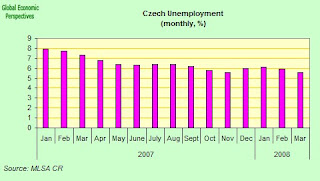


As a result the number of registered unemployed dropped to 336,297, down 18,736 from the preceding month and down 94,177 from a year ago, according to data from the Czech Labor and Social Affairs Ministry earlier this week.


And employment has also been rising rapidly, with the number of first (main) jobholders in Q4 2007 reaching 4 967.3 thousand, up by 105.6 thousand (+2.2%) year-on-year. Employment thus reached it highest level since the start of 1997.


One evident consequence of this steady increase in employment and decline in unemployment is that labour shortages are now a growing reality in the Czech Republic, and one clear indication of this is the fact that the number of unfilled job vacancies is also steadily increasing, hitting a record 151,311 at the end of last month.


So with the Czech economy creating jobs at a rate of over 100,000 a year, and with unemployment falling at 95,000 a year, and realistically assuming that not all the 300,000 or so unemployed who remain are employable, then the Czech Republic may be what, 18 months or so away from running out of workers at this point. Of course, long before you actually get to run out of workers, you hit the limits of the inflation-free rate of growth which is possible with the workforce which remains, as we have been seeing in one East European economy after another, (and as we may now even be seeing in China). This is why the recent surge in Czech inflation, despite the slight fall back this month, should be giving some cause for concern over at the central bank.

And the situation is in fact even more complicated than these numbers reveal, since if we look at the chart below, which shows a breakdown of the Czech 2007 population by five-year age groups, then we can see that the largest cohort is now in the 30 to 34 age group, and after this each subsequent group has less people coming up behind them. Worse, the 55 to 59 age cohort is significantly larger than either the 15 to 19 one or the 20 to 24 one, which means that as people retire there will increasingly be less people entering the labour market to replace them, and especially since the tendency is for young people to spend an increasing number of years in training and education.


The root of the problem here is long term fertility, which only really crashed to very low levels in the 1990s, but which has, as can be seen in the chart, been hovering nervously below the replacement level since the late 1960s (with some ups and downs).


The result of this is the number of children being born has been dropping back continuously since the mid 1970s, and it is this process more than anything else which gives the current Czech population structure its very peculiar present shape.


So Is Migration The Answer?

Certainly migration can help (as can increasing participation rates among older workers) but the numbers involved are really quite large for a comparatively small country, and there are issues about preparedness to adapt to becoming a multi-cultural society (everything in Eastern Europe is just happening so quickly). The changeover is, however, taking place and foreigners now make up almost 4 percent of the Czech Republic's population (which is currently a little over 10 million), with the number of migrant workers in the country rising steadily year by year, and in particular in 2007. According to data from the Czech Statistical Office at the end of last year there were a total of 392,100 foreigners with long-term or permanent residence permits living in the Czech Republic. This was up by 70,600 in 2007 alone.


The largest group of foreign migrants with rights to work in the Czech Republic comes from Slovakia. At the end of last year, 101,233 Slovakians were legally worrking in the country. Ukranians are the second most numerous group with 61,592 working in the Czech Republic last year. The number Mongolian and Vietnamese workers is also increasing rapidly. In 2007 there were 6,897 Mongolians working legally in the CR (up from 2814 in 2006) and 5,4425 Vietnamese (up from 692 in 2006). The numbers of Vietnamese actually in the country is undoubtedly much larger, and according to the Czech police, there are almost 51,000 Vietnamese holding long-term or permanent residence permits for the CR, many of them with temporary student visas. Demand in Vietnam is also way up, and the Czech embassy in Hanoi had to close its doors to visa applicants temporarily in March to reorganise itself in order to cope with the influx.


It is evident that the Czech Republic's labour shortages are now making their present felt across the economy as a whole, and the world of business is now waking up to the implications of this situation. Bloomberg had an in-depth article earlier in the week, where they quoted Jiri Cerny, vice president of Toyot and PSA Peugeot Citroen's joint venture in the Czech Republic, as saying that three years after opening shop in the country he feels it is getting harder by the day to find workers, as a result he is now actively considering importing them from Mongolia.

TPCA, the Toyota-Peugeot joint venture about an hour outside of Prague, shows the strains created by this new investment. Along with average wage growth of more than 40 percent since the Czech Republic joined the EU in 2004, managers like Cerny also face a labor shortage that means they can't recruit all the workers they need just by offering higher pay.

"It's difficult; we are always looking for employees," says Cerny, wearing the plant's trademark gray overalls as he bounces between budget meetings and the factory floor. To find qualified workers, "we're thinking about Vietnam right now, as well as Mongolia," he says.


This story is being repeated in one country after another across Eastern Europe as companies that were attracted by the promise of cheap and plentiful labor are finding less of both, as faster growth drives up wages and open borders encourage emigration. Indeed there is increasing speculation that accelerating inflation may cause eastern Europe's investment- led boom to fizzle (and possibly even crash to a dead stop), with the Baltics and Balkans regions already threatened by a "hard landing" according to the International Monetary Fund and Standard & Poor's.

Of course in the short term migration will undoubtedly help, but in the longer run sustainability is going to be all about getting that fertility rate back up again, at least to something approaching replacement level, otherwise "catch up" economic growth will be simply unsustainable, while the pension and health systems will buckle under the weight of the large elderly population.


Update Thursday 10 April 2008


Development since I wrote this post only serve to confirm just how complex all of this is now becoming. This morning Czech central bank Governor Zdenek Tuma has an interview in the magazine HVG. He exxplaines in the interview that Czech monetary policy makers have kept interest rates down as low as possible in order to try to avoid excessive strengthening of the Korune. The central bank, which last met on March 26 and kept the 14-day repurchase rate at 3.75 percent, expects the inflation rate to fall to 5 percent by September and 3 percent next year from 7.5 percent in February, Tuma told the Budapest-based magazine.

``The low interest rate-level isn't surprising when you look at the past few months,'' he said in the interview published today. ``When an economy is catching up to a more advanced region, its national currency usually appreciates. That's what's happening in the Czech Republic.''


At the same time the Czech Cabinet have approved this week an agreement with the central bank designed to avoid putting more pressure on the koruna, so that it does not start weighing excessively on exports. The plan, submitted by Finance Minister Miroslav Kalousek, was passed by ministers at a weekly meeting in Prague yesterdat, reviving a similar arrangement made in 2002.

The objective is to keep the foreign-currency proceeds from state asset sales and European Union funds off the market to limit demand for the koruna. The plan is the result of an ``agreement with the Czech central bank on a series of measures which should work against the trend of the appreciating koruna,'' Kalousek told reporters.

The Czech government plans to sell state assets such as the national airline Ceske Aerolinie AS as early as this year. The government also wants to sell Lestiste Praha AS, operator of Prague's international airport, which could generate as much as 100 billion koruna ($6.3 billion). Kalousek said revenue from sales of state assets will be frozen on a foreign exchange account at the central bank and kept for an overhaul of the pension system. If the government needs part of the funds, it would use foreign exchange swaps until it adopts the euro in the future, he added.

If the Finance Ministry was to issue Eurobonds then ``we will hedge them so they have no impact on exchange rate developments.''


This is a reference to a ministry statement last December that it may sell euro-denominated debt this year with a value equal to no more than 50 percent of its annual borrowing needs of 180 billion koruna, depending on market conditions.

The Czechs are also entitled to receive as much as 26.7 billion euros ($42.1 billion) in EU funds during the period of 2007 to 2013. Kalousek said he is not in favour of hedging funds coming from the European Union as that would contribute to koruna appreciation and would weigh on exporters.

It ``would mean a transfer of all of the negative impacts on Czech exporters,'' he said. ``Both the public and private sectors must share exchange rate risks.''

Tuesday, April 08, 2008

Czech Trade Surplus February 2008

The Czech trade surplus swelled in February to the largest in 11 months as exporters withstood the effect of the appreciating currency. The positive balance reached 14.3 billion koruna ($893.6 million) after January's 12.2 billion koruna and 12.9 billion koruna in February 2007, the Prague-based statistics office said earlier today.


February exports amounted to 215 billion koruna, increasing 11.4 percent from the same month of last year and led by vehicles and machines. Imports totaled 200.8 billion koruna, up 11.5 percent from a year earlier.


Czech monetary policy makers refrained from raising borrowing costs in March over concerns about the strong koruna and the prospect of a sluggish economy in the euro area will contain inflation and curb local economic expansion.

Czech Inflation March 2008

The Czech Republic's March inflation dropped back slightly in March for the first time since last July, led by slowing growth in the cost of food and holiday packages. The annual inflation rate fell to 7.1 percent from 7.5 percent in February, when it was the highest in a decade, according to data from the Prague-based statistics office earlier today. Consumer prices fell 0.1 percent from February, when they gained a monthly 0.3 percent.


Prices of food fell 0.3 percent in the month and were 10.8 percent higher than a year earlier. Costs of packaged holidays fell 2.7 percent in the month.

Price growth is expected to be contained to some extent by the koruna's 12 percent gain against the euro so far this year.


Slowing economic growth and the waning effect of Jan. 1 tax and regulated price increases are also hoped to have an effect. It was these arguments that lead rate setters to refrain from lifting Europe's second-lowest benchmark interest rate last month after raising it to a six-year high of 3.75 percent in February.


The central bank's February forecast anticipates an inflation rate of 5.3 percent in the fourth quarter and a 2.4 percent rate in the second quarter of 2009. The preferred mid-point of the central bank's inflation objective is 3 percent. Inflation breached the bank's 4 percent ceiling for a fifth month in a row in March due to the global growth in food and oil costs and a jump of indirect taxes and state-controlled prices such as rents and energy. Policy makers however are inclined to place more emphasis on the so-called second-round effects of cost price shocks and tax adjustments such as elevated wage-growth demands that could thwart inflation's return to the desired level.

Indeed this is the interpretation placed on the situation by Czech National Bank board member Eva Zamrazilova speaking at a central bank conference in Prague this morning:


"The data show that the current surge of the inflation rate will be limited by time, the situation will gradually calm down and in early next year, inflation will return to levels very close to our target," she said "Today's figure fully corresponds with an outlook of stable interest rates in the near term"


Things may however not be quite so neat and tidy.

True wage inflation has been slowing, and Czech real wage growth slowed the most in two years in the last quarter of 2007 even as inflation accelerated. The average monthly paycheck rose 1.9 percent when adjusted for inflation, compared with growth of a revised 4.9 percent for the preceding three-month period. The average gross monthly salary advanced 6.8 percent to 23,435 koruna ($1,435). For whole year 2007, real wages were up 4.4 percent, the fastest rate of increase in four years.

Czech Unemployment March 2008 and the Need For Migrant Workers

The Czech unemployment rate fell to 5.6 percent in March as sustained economic growth continued to create more jobs. The rate fell from 5.9 percent in February.


The number of registered unemployed dropped to 336,297, down 18,736 from the preceding month and down 94,177 from a year ago, according to data from the Labor and Social Affairs Ministry this week.


Labour shortages are growing with the number of job vacancies increasing to a record 151,311 at the end of last month.


And employment has also been rising rapidly, with the number of first (main) jobholders in Q4 2007 reaching 4 967.3 thousand, up by 105.6 thousand (+2.2%) year-on-year. Employment thus reached it highest level since the start of 1997.


So with the Czech economy creating jobs at a rate of over 100,000 a year, and with unemployment falling at 95,000 a year, and realistically assuming that not all the 300,000 or so unemployed who remain are employable, then the Czech Republic may be what, 18 months or so away from running out of workers at this point. Of course, long before you actually get to run out of workers, you hit the limits of the inflation-free rate of growth which is possible with the workforce which remains, as we have been seeing in one East European economy after another, (and as we may now even be seeing in China). This is why the recent surge in Czech inflation, despite the slight fall back this month, should be giving cause for concern over at the central bank.


Is Migration The Answer?

Certainly migration can help (as can increasing participation rates among older workers) but the numbers involved are really quite large for a comparatively small country, and there are issues about preparedness to adapt to becoming a multi-cultural society (everything in Eastern Europe is just happening so quickly). But the change is taking place and foreigners now make up almost 4 percent of the Czech Republic's population (which is currently a little over 10 million), and the number of migrant workers in the country has been rising steadily year by year in recent years, and in particular in 2007. According to data from the Czech Statistical Office at the end of last year there were a total of 392,100 foreigners with long-term or permanent residence permits living in the Czech Republic. This was up by 70,600 in 2007 alone.


The largest group of foreign migrants with rights to work in the Czech Republic comes from Slovakia. At the end of last year, 101,233 Slovakians were legally worrking in the country. Ukranians are the second most numerous group with 61,592 working in the Czech Republic last year. The number Mongolian and Vietnamese workers is also increasing rapidly. In 2007 there were 6,897 Mongolians working legally in the CR (up from 2814 in 2006) and 5,4425 Vietnamese (up from 692 in 2006). The numbers of Vientamese in the country is undoubtedly much larger - according to the Czech police, there are almost 51,000 Vietnamese holding long-term or permanent residence permits for the CR, many of these with student visas.


Certainly the Czech Republic's labour shortages are now making their present felt across the economy as a whole. Bloomberg had an in-depth article earlier in the week, where they quoted Jiri Cerny, vice president of Toyot and PSA Peugeot Citroen's joint venture in the Czech Republic, as saying that three years after opening shop in the country he feels it is getting harder by the day to find workers, and he is now actively considering importing them from Mongolia.

TPCA, the Toyota-Peugeot joint venture about an hour outside of Prague, shows the strains created by this new investment. Along with average wage growth of more than 40 percent since the Czech Republic joined the EU in 2004, managers like Cerny also face a labor shortage that means they can't recruit all the workers they need just by offering higher pay.

"It's difficult; we are always looking for employees," says Cerny, wearing the plant's trademark gray overalls as he bounces between budget meetings and the factory floor. To find qualified workers, "we're thinking about Vietnam right now, as well as Mongolia," he says.


This story is being repeated in one country after another as companies that were attracted to the formerly communist nations in eastern Europe by the promise of cheap and plentiful labor are finding less of both, as faster growth drives up wages and open borders encourage emigration. Indeed there is increasing speculation that accelerating inflation may cause eastern Europe's investment- led boom to fizzle (and possibly even crash to a dead stop), with the Baltics and Balkans regions already threatened by a "hard landing" according to the International Monetary Fund and Standard & Poor's.

Of course in the short term migration can help, but in the longer run sustainability is going to be all about getting that fertility rate back up again.


Wednesday, March 26, 2008

Czech Central Bank Keeps Interest Rates on Hold

The Czech koruna fell against the euro today following the decision by the Czech central bank to keep what are till the European Union's lowest interest rate on hold to try to restrict the ongoing rise in the currency. This is a very tricky game to play indeed, and the bank effectively bucked the trend among other the other EU10 central banks who have some sort of autonomy left over their monetary policy (Romania raised rates today, as did Poland, while we could say that in Slovakia - where they have incraesingly less monetary policy options left by the day as they make one last desperate effort to converge with the eurozone despite a sudden acceleration in inflation and GDP growth - the decision not to raise was effectively taken for them, since they cannot afford to enter EMS with an excessively high partity rate with the euro).

The Prague-based bank left the repurchase rate where it was,at 3.75 percent. The koruna has gained 8 percent against the euro in the past six months alone, ranking it as the world's best performer during the period of global financial turmoil.

The Czech currency fell as much as 0.8 percent following the news, down to 25.662 per euro and was at 25.502 by 5:22 p.m. in Prague, from 25.471 yesterday. It has now fallen 1.8 percent since the central bank said March 18 it will freeze the proceeds from state-asset sales.

Policy makers want to revive a 2002 accord whereby foreign- currency proceeds from the sales would be put in a special account to keep fund flows out of the market and limit demand for the koruna, Deputy Governor Mojmir Hampl said. Policy makers are concerned more rate increases, after eight in the past two and a half years, would push the koruna even higher, threatening to become completely counter productive.

``The bank board has consensually agreed that the decision- making is uneasy and risks of leaving the current rate trajectory are relatively high,'' central bank Deputy Governor Miroslav Singer said today. ``We perceive the situation as burdened with balanced but substantial risks in both directions.''

Tuesday, March 18, 2008

Czech Retail Sales January 2008

Czech retail sales grew at the slowest annual rate in four months in January as accelerating inflation curbed shoppers' purchasing power, supporting speculation that interest-rate increases may not continue. Sales rose 4.1 percent, compared with an annual increase of 5.4 percent in December, the Czech Statistical Office said today.


Retail sales, excluding cars and motor fuels, were up by 3.3 percent and were 4.9 percent higher when seasonally adjusted, led by clothing, furniture and electronics. Sales of cars and motor fuels grew 6 percent.

Consumer spending has eased back as inflation accelerated to 7.5 percent in January from 1.3 percent a year earlier. The central bank expects cooling household spending, the main driver of economic growth in the past two years, to restrain the Czech expansion back to a 4.1 percent GDP growth in 2008 from 6.5 percent 2007. If today's data give them some encouragement to believe they are succeeding then they may well leave the main interest rate at its current 3.75 percent. Certainly with an average inflation rate this year of over 6 percent and nominal wage increases of around 8 percent, real salaries may well increase by less than 2 percent following the 4.4 percent increase in real wages in 2007. So this would definitely be a move in the right direction if it can be sustained.

The koruna fell to 25.208 per euro by 10:47 a.m. in Prague, compared with 25.141 yesterday. The ask yield on the government benchmark bond maturing in 2018 rose 5 basis points to 4.59 percent.

Czech Producer Prices February 2008

According to the latest release from the Czech Statistics Office prices of agricultural and industrial producers were up in February by 0.7% and 0.1%, respectively over January, while prices of construction work and market services grew by 0.4% and 1.1%, respectively.

In comparison to February 2007, prices of agricultural and industrial producers increased by 27.1% and 5.6%, respectively; prices of construction work and market services were up by 4.5% and 3.4%, respectively. That is core industrial producer prices are now rising at a 5.6% annual rate.


Agricultural producer prices grew by 0.7% in total. Prices of crop products rose by 2.0% due to higher prices of cereals (+3.4%). Prices of potatoes, fruit and vegetables fell by 5.8%, 2.3% and 1.7%, respectively. Prices of animal products fell by 1.0%; lower were prices of milk (-0.2%), poultry (-1.6%) and pigs for slaughter (-3.6%). Higher prices were recorded for eggs (+0.9%).

Industrial producer prices rose by 0.1% (+1.9% in January). The growth of price level came mainly from higher prices in ‘basic metals and fabricated metal products’ (+0.6%), ‘machinery and equipment” (+0.9%) and “chemicals, chemical products and man-made fibres’ (+1.1%). Prices increased in 'food products, beverages and tobacco’ by 0.2%, of which the most marked increase was recorded for ‘animal and vegetable oil and fats’ by 6.7% and ‘prepared animal feed’ by 2.4%. On the other hand, prices dropped in ‘meat and meat products’ by 1.6% and ‘dairy products and ice cream’ by 1.4%. Prices decreased in ‘transport equipment’ by 0.9%, ‘coke, refined petroleum products' by 0.8% and in ‘rubber and plastic products’ by 0.6%.

Construction work prices rose by 0.4%, and so did prices of construction material input (+0.6%).

At the same time export prices decreased by 2.6% in January (following a 2.1% decrease in December) dropping for the third month in a row. The underlying reason for this improved performance is undoubtedly the appreciation of the koruna. The biggest price decreases were registered in ‘miscellaneous manufactured articles’ which were down by 5.2% (particularly articles of apparel and clothing accessories), ‘machinery and transport equipment’ down by 4.9% (especially general industrial machinery and equipment) and ‘chemicals and related products’ down by 3.8%. In contrast, the highest price increases were recorded for ‘food and live animals’ - up by 12.7% (mainly cereals and cereal preparations) - and ‘mineral fuels, lubricants and related materials’ - up by 18.0% (particularly coal, coke and briquettes and electric current).


Monday, March 10, 2008

Czech Inflation and Unemployment February 2008

Czech consumer prices rose by 0.3 percent in February, keeping annual inflation at the nine-year high of 7.5% which it reached in January, the statistical bureau said on today. Price growth was driven mainly by housing prices, including water and heating, and kept open the possibility that the central bank will raise interest rates once more in the next few months. A separate set of figures from the Labour Ministry showed unemployment fell to 5.9 percent in February from 6.1 percent in the previous month.


The data lacked the kind of negative surprise impact which shocked the market in January but this continuing high inflation may well prompt more monetary policy tightening. The central bank has raised the main repo rate by 200 basis points to 3.75 percent as the economy grwon at a tidy clip over the past three years.

The central bank has acknowledged inflation is still 0.6 percentage points above its fresh forecast, and has been struggling to try to anchor inflation expectations, suggesting that the current spike is largely a short-term deviation.


A major anti-inflationary factor has been the rise in the value of the koruna, which currently stands up some 11 percent year-on-year against the euro. It has been cooling off from the record 24.83 seen on March 4, and briefly dipped to 25.125 after the inflation data from 25.095 before but then firmed back to 25.033 by 1310 GMT.

There are various risks to the banks inflation forecast on both the supply and demand sides. One clear danger if that the rapid rise in some prices, even if only temporary, creates higher costs for businesses that may lead to rises in other prices as well as higher expectations for higher inflation among Czech consumers and companies. This risk may well prompt the Czech central bank to raise rates either this month or in the not too distant future.

On the supply side there are gowing pressures from labour shortages in some sectors. Separate unemployment data out today from the Ministry of Labour and Social Affairs showed the number of jobless fell to 5.9%, its third lowest level since 1998 in what is already tight labour market, further boosting the case for a rate hike.

In February the Czech employment offices registered a total of 355,033 job seekers. That is 9,511 less than at the end of January, and 99,704 less than in February 2007. The number of available job seekers (job seekers currently available for work) was 330,641. In the course of February, job offices registered a total of 40,002 first signings. That is 23,152 job seekers less than in January and 718 newly registered job seekers less than in February 2007. In February job offices registration was terminated by 49,513 job seekers. New jobs have been taken up by 31,735 persons.


In February 2008 the unemployment rate was 5.9 % (January 2008: 6.1 %, February 2007: 7.7 %). The unemployment rate was higher than average in 35 districts, the highest being in Most (14.9 %), Karviná (13.1 %), Znojmo and Jeseník both (11.9 %) and Teplice (11.8 %). The lowest unemployment rate was in the districts of Praha–východ (1.7 %), Praha–západ (1.9 %), Praha and Mladá Boleslav (both 2.2 %). The unemployment rate for women was 7.2 % and the unemployment rate for men was 5.0 %.